Current Issue
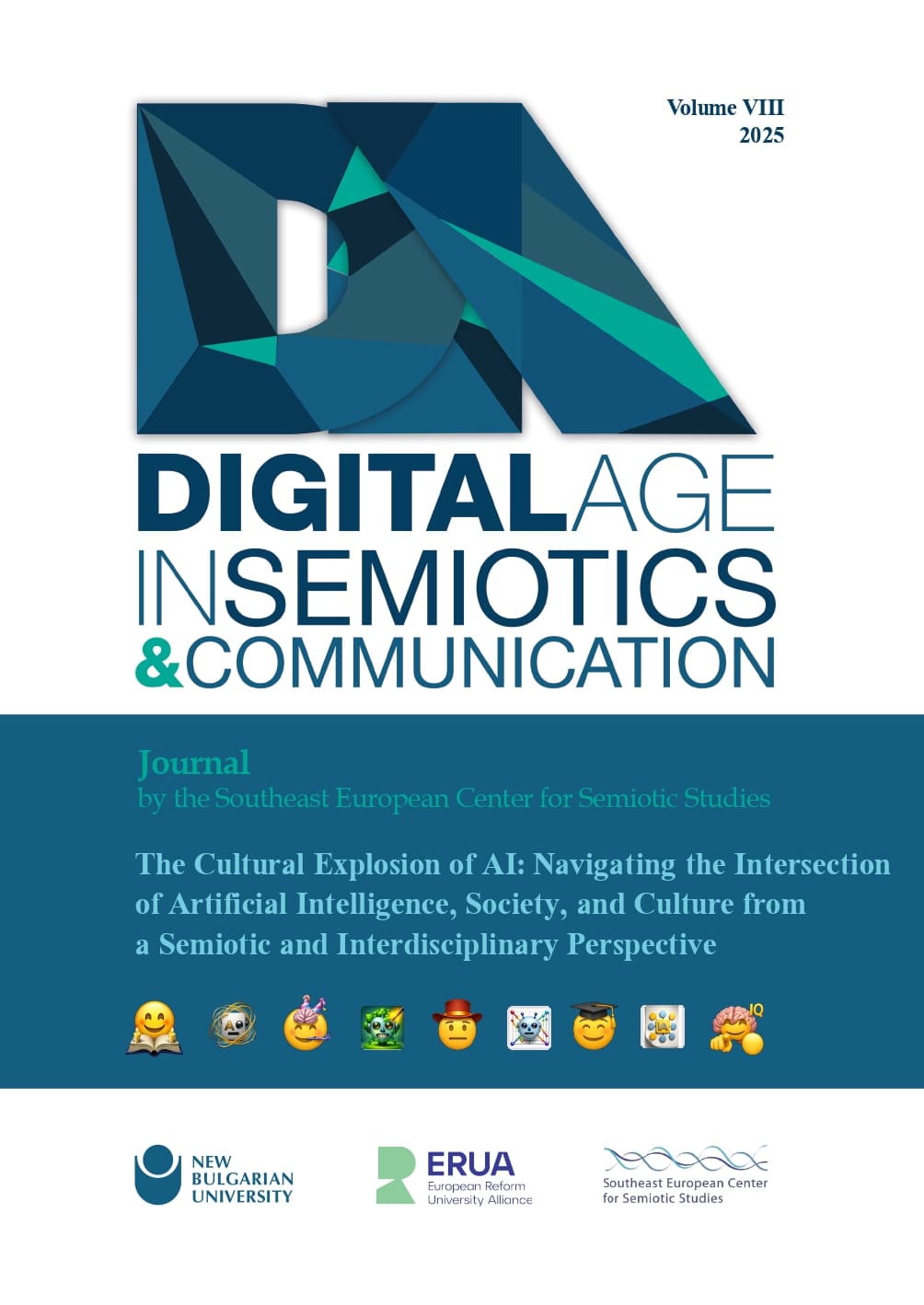
Volume VIII of Digital Age in Semiotics & Communication (2025) edited by Kristian Bankov and Federico Biggio, brings together thirteen articles on how artificial intelligence is reshaping meaning, culture and communication. The collection opens with a co-authored primer bridging semiotics and machine learning, followed by a Peircean reading of the architecture of large language models and a pragmatic comparison between human and machine sense-making. Other contributions examine text-to-image generation through Susanne Langer’s aesthetics, and the first part of a computational-semiotic study of facial recognition, continued in Volume IX. AI creativity is explored in extended reality, while a cognitive-science perspective links 5E cognition to narrative, and an economic analogy describes the “semiotic inflation” produced by machine-generated content. Biosemiotics extends the discussion to animal communication. Several articles address education and practice: a mixed-methods study of ChatGPT in higher education, AI in second-language acquisition, a consumer survey on attitudes towards AI-generated content, and the transformation of the fashion industry. Across these perspectives, none of the authors grants AI human-like interpretative agency; instead, AI is treated as tool, interlocutor, producer of signs and catalyst of cultural change.